Behind the Code: How Developer Choices Shape Bonus Triggers and Payout Patterns in Portable Casino Titles
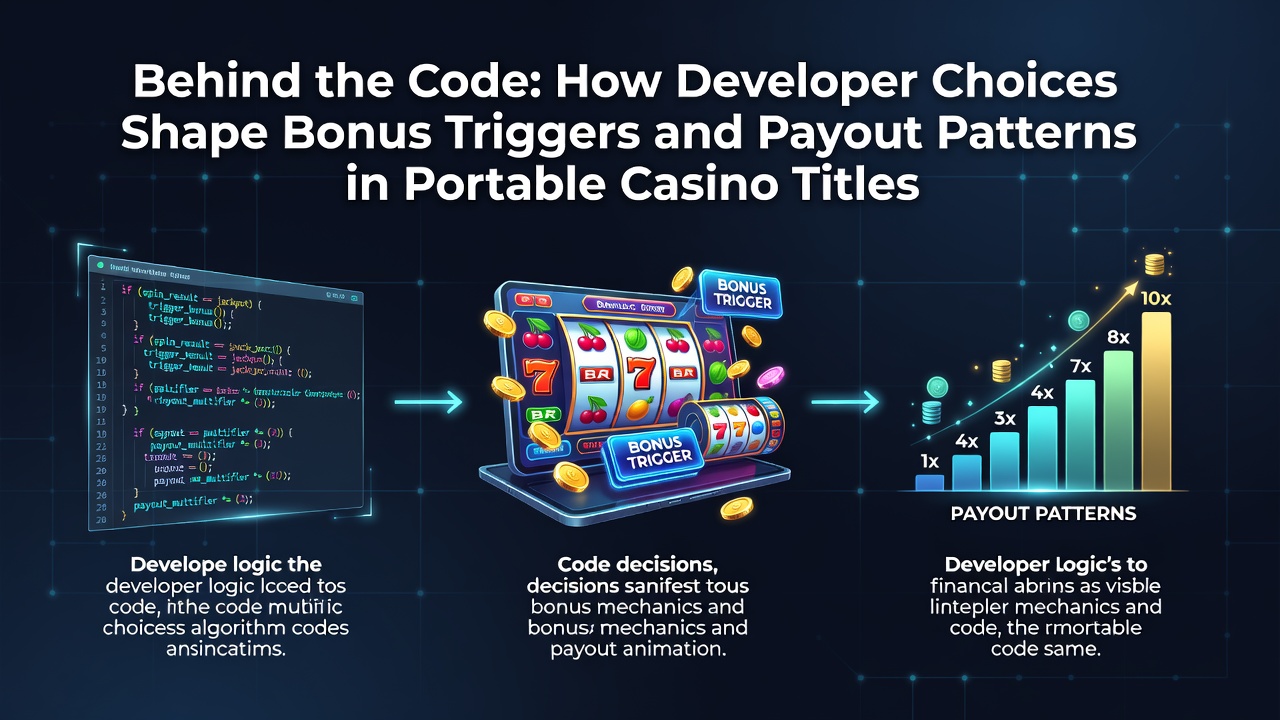
Developers working on portable casino titles make deliberate decisions about random number generators, probability tables, and state machines that directly influence how often bonus features activate and how payouts distribute across player sessions. These choices start at the design phase where teams define the core mathematics before any graphics or sound enter the build, and the resulting code determines whether a game leans toward frequent small rewards or rarer large swings.
Random Number Generation and Its Direct Impact on Triggers
Most portable slots rely on pseudorandom number generators seeded at the start of each spin, yet the way developers map those outputs to reel stops and feature entry points creates measurable differences in trigger frequency. Some studios implement weighted tables that increase the chance of landing specific symbol combinations only after a set number of spins have passed without a bonus, while others keep the distribution strictly uniform across the entire cycle. Research from the University of Nevada's gaming laboratory shows that slight adjustments to these weighting functions can shift bonus activation rates by several percentage points without altering the overall return to player figure.
Engineers also decide whether the RNG continues running during idle periods or pauses until the next bet registers, a choice that affects perceived fairness and can influence player retention patterns over long sessions. When the generator stays active in the background, certain games produce bonus entries that feel more organic because they occur independently of the player's timing, whereas paused implementations tie every outcome explicitly to the moment of the spin button press.
Bonus Trigger Architecture Choices
The architecture behind bonus triggers often splits between simple reel-based scatter detection and more complex layered systems that track accumulated values across multiple spins. Developers who favor the layered approach must store persistent counters in local memory or server-side profiles, introducing decisions about data synchronization that can create slight delays or desyncs on mobile networks. These technical trade-offs become visible in payout patterns when players switch between devices or experience brief connection drops, because the stored state either resets or resumes depending on how the code handles reconnection logic.
Another common fork appears in the way studios set threshold values for feature entry. Some titles require exactly three scatter symbols anywhere on the reels, while others use expanding windows or dynamic requirements that change based on current stake level. Data from industry testing labs indicates that dynamic thresholds tend to produce more even distribution of bonus events across different bet sizes, whereas fixed counts create steeper differences between minimum and maximum stake play.

Payout Pattern Construction Through Code Parameters
Once a bonus round begins, the developer's earlier decisions about multiplier ranges, reel expansion rules, and retrigger probabilities take over. Code that caps multipliers at lower values but allows frequent retriggers produces steadier credit growth compared with implementations that offer high ceiling multipliers with strict retrigger limits. Observers note that the former approach often results in smoother bankroll curves on mobile sessions lasting under thirty minutes, while the latter creates more dramatic spikes that appear in aggregated session data from testing environments.
Teams also determine whether bonus rounds use the same RNG stream as the base game or switch to a separate pool, a choice that alters the correlation between base game symbols and feature outcomes. Separate pools let developers fine-tune volatility independently for each mode, yet they require additional validation steps to ensure the combined return to player remains within regulatory tolerances across different markets. A report published by the Australian Gambling Research Centre highlights how such separation techniques appear more frequently in titles released after 2024 as studios respond to varying jurisdictional requirements for transparency in feature mechanics.
Device-Specific Optimizations and Their Ripple Effects
Portable titles must account for differences in processing power and screen size when rendering animations during bonus sequences. Developers sometimes reduce the number of simultaneous particle effects or simplify reel physics on lower-end devices, yet these optimizations rarely touch the underlying payout tables. However, the decision to preload certain assets versus streaming them can indirectly affect session length, because players on slower connections may exit before a bonus fully resolves if the code does not prioritize critical visual feedback.
Memory management routines also play a role. Games that aggressively clear cached reel data after each spin free up resources for background calculations that might adjust near-miss frequencies, whereas those that retain more data in memory can implement more sophisticated pattern recognition for adaptive difficulty. Both strategies remain within accepted technical standards, yet they produce distinct statistical signatures when large datasets of mobile play sessions undergo analysis.
Conclusion
Developer choices in random number mapping, trigger architecture, payout parameter ranges, and device-level optimizations combine to create the observable patterns players encounter in portable casino titles. These decisions occur long before launch during iterative testing cycles that measure trigger rates and credit distribution across thousands of simulated spins. As platforms evolve, the same underlying code principles continue to guide how new features integrate without disrupting established payout behaviors, ensuring consistency across updates released through 2026 and beyond.